


Ideal standard

Interview with Kees Kaan
By Renata Margaretić Urlić and Ivan Rupnik
Delft Engineering University executive board president, KEES KAAN, better known as one of the partners of the illustrious Dutch office Claus en Kaan Architects, established in 1988. At two addresses, in Rotterdam and Amsterdam, the office currently brings some sixty architects together, and has realized numerous recognizable international projects in the past two decades, along with shaping the Dutch environment. From the reconstruction of Amsterdam’s harbor docks into residential districts and numerous other housing complexes which they developed back in the 90’s, via the Dutch Embassy in Mozambique, a building that made the rounds in every current professional journal worldwide, followed by a hotel near the railway station in Amsterdam or the Cultural Center in Nijverdal, to their most recent assignment, the expansion of the Mauritshuis Museum in the Hague. All of their projects are examples of recognizable Dutch characteristics, branded with the Klaus en Kaan stamp of identity.
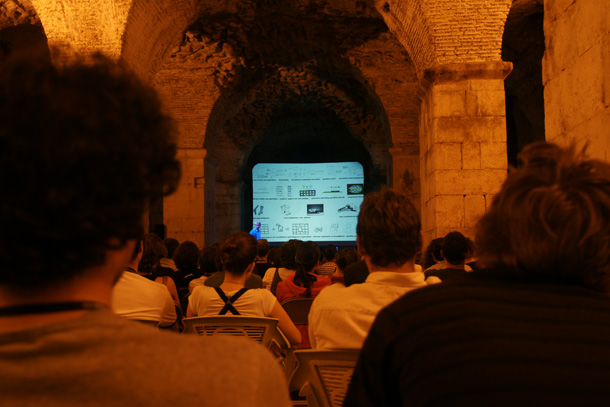
We talked to Kees Kaan on the Split Riva, in front of the entrance to the cellars of Diocletian’s Palace, following his lecture which was adapted so as to be in line with the theme of SplitTalks. In lieu of the usual laundry listing of his office’s “brightest pinnacles”, Kaan introduced his team’s approach to the research of modern urban planning, their thoughts on shaping the urban environment, that is, the metropolitan area in the Netherlands where the borders of certain towns have been erased. Are we living in the suburbs of Amsterdam, Paris or London, is a question not only Kaan can pose but his fellow countrymen as well, with a TGV map in hand.
However, as town development is dependent on the speed of its railways, we asked him at the beginning of our interview what were the conditions of the radical changes that have occurred in housing policies, development and the market in the past thirty or so years.
A: Numerous aspects of commercialization which are visible in the media and politics today had started as early as the eighties and in the urban planning industry. Due to monopolization changes over housing corporations, stronger requests for bringing a law on apartment ownership of every individual resident had started to surface. That meant that instead of developing welfare residences based on renting apartments, apartment developments intended for free market purchasing were starting to take hold. This type was more or less identical to that which was being developed for welfare residences in the beginning, but soon started to shift as the market implied the critical mass, that is, various interests. All that happened simultaneously with changes in economic and social relations, and one of the consequences was figuring in a woman’s income in a joint mortgage. That increased a family’s probability of buying a house for a while, but at the same time the prices of an average house increased, following the amounts that people could put aside for them. Thus, the quality began to grow, not only in a technological sense, but a spatial one as well. Which, in turn, provided architects with the opportunity to research and analyze diverse typologies, etc. Smaller projects such as the Borneo Sporenburg in Amsterdam and many others were rendered possible precisely because of that transition to market economy. Ten years earlier that wouldn’t have been possible, same as it’s impossible today due to the conservative nature of the market, and those were highly innovative projects.


*Sporenburg Amsterdam
Q: You started your lecture by offering an explanation as to why Dutch architecture isn’t as good as it used to be during the 90s. It seems to me that it would have been more interesting to ask why it was so brilliant in the first place? One of the more interesting explanations is that the moment of transition was excellently put to use, although it didn’t seem so at the time. That market opened up towards numerous varied experiments, thus the housing corporations kept all that individual work together, and then the transitional tendencies disappeared…
A: … and likewise, the power of the project proponents’, city authority’s and housing corporations developers gradually subsided. That’s what I wanted to explain earlier while talking about the way the media and commercials facilitated daily changes of fashion and thus rendered the management of innovative ideas that much difficult, as who would want to take on a risk of such huge proportions? Nobody wants to take on such a decision anymore, it’s impossible. That which is happening today is an obvious thwarting of long term anticipations and long term planning, for which conservative powers and forces, created by a society dependent on the market and the media, are responsible, hence, it’s the individuals that are essentially highly conservative…
Q: … as they were before, only today the system allows them to be conservative…
A: … indeed, correct, and some experiments were quite successful, but not all. Those circumstances resulted in some successful projects, while on the other hand, that same system drove certain things to ruin.

Q: You mentioned the “ideal standard” in your lecture, which sounds like an excellent slogan for attracting clients. In what ways has the market context changed the role of the architect in the meantime, from the period we talked about until today?
A: The idea of branding architecture has become super important! Likewise, the fact that we have become Europeans commits us to adhere to European rules. Client rotation has taken place in the meantime, as well as a change in the selection process of architects and projects, which have predominantly started to take place according to the European system of supply and demand, including both tenders and market mechanisms. That means that architects have to provide attractive images and sweep people off their feet. “Now we have to seduce people to live in that”, is literally what our clients tell us when we design according to their commission. We must, by all means, change the project so as to continue the collaboration, and that means branding and attractive images have become that much more in demand. The problem of course lies within the fact that we as architects have to live with it. To me it seems like a bridge which has to be used to overcome the gap between the image we sell and the realistic project idea. That’s why realization takes so long, as we are included, as architects, from the very beginning and literally used to sell ideas, to provide developers and town politicians with “seductive imagery”. Thus, even before they start to think about the conditions of the program, even before they contemplate the idea of selling something, we need to provide them with an “image”. Only then, when they have that image, can they start raising money, formulating plans, employing architects, and prior to everything else, seeking approval from the public, i.e. the community.

Q: How do Claus en Kaan Architects deal with that issue? What is your strategy of avoiding the seductive imagery?
A: We have attempted to keep a relative flexibility in our projects, so as to be able to further change and move them, i.e. so that they aren’t pinpointed by any one image. However, at the same time, we wanted to be completely precise in the matter. Thus we named it the ideal standard. That means we let a lot of opportunities for the realization of projects pass us by. Namely, we lose proposals quite often, as the image we produce isn’t attractive enough, but, as we have been criticized, cold and hard. However, we don’t want to promise something we can’t deliver. We much rather like to finish what we start, bearing in mind that what is built has to be better than the image preceding it. We leave no room for disappointment. Within the concept guidelines upon defining a project, we make an effort to anticipate the development and construction process, so as not to let it “slip out of our hands”. Feel free to call us conservative and say that we play it safe, but we deliver what we promise, and to the best of our abilities at that. There are some architects who will say: it’s alright, we will develop that to the highest possible level, as it’s such a fantastic idea! But then following construction you find out that much of the original idea has been lost along the way, thus creating fertile ground for disappointment. I prefer the safety of knowing that we will actually build that certain something and that that structure, upon handing it over to its users, will take on a character of its own. That character should be of such strength so as no shifts can damage it, so simple and strong that society can accept it, and people are able to comfortably live and work in it. Structures should be generous towards its users, not obsessed with the architect’s personal agenda. I prefer projects with such qualities, that manifest themselves when you visit them and experience their strength, and not to have to face all the things the architect wanted, which fell through and didn’t become architecture with a capital A in the end.
Q: In addition, it was an interesting idea regarding the collective or togetherness which you mentioned at your lecture, especially being of interest to us due to our experience of “the collective” in the past, that is, a socialist ownership structure. To what degree is that idea possible in a contemporary Dutch society in view of the political situation?
A: That which happened in the Netherlands, as anywhere else for that matter, was a tendency towards individualism, particularly in the eighties, when the market was booming. Borneo and Sporenburg, the one time port sections, i.e. Amsterdam docks which were turned into residential areas are an extreme case in point. The public space was reduced at the expense of individual areas, personal territories. However, that didn’t result in ideal living conditions. Certain possibilities which imply collectiveness were amiss. Namely, in that particular project we were restricted in the possibilities of finding solutions for joint areas such as parking lots and others. Within the context of the same market in Rotterdam, followed by Amsterdam, we had then started to develop high-rises such as Montvideo and other projects where the residents had a pool, saunas, etc., what was, likewise, a unique quality. Thus, on the one hand you’ve got the quality of individual space, while on the other, certain services, i.e. qualities which you can’t have in individual houses. That also opened the floor for discussion in the media with a clear request: if you can place those qualities in towers, then program them in low-rises as well! Why shouldn’t we have pools, gyms and other modern-life conveniences in horizontal blocks as well? Naturally there were people who wanted to live in such complexes, although that was contrary to our ideas and the town’s conventions. In the city, namely, we have to accept collectivity in large vertical housing blocks, but as soon as it’s about the horizontal ones, we don’t want togetherness anymore. I think we can even increase the density in the way we did in our complexes in Borneo and Sporenburg in Amsterdam, but when we reached certain limits, when we were supposed to continue, we should have included some level of togetherness that can also be found in high-rises. They opened up new possibilities and it was worth looking into which were the ideal types, what would be the ideal measurements for elements or the ideal skills with which a good quality public area could still be preserved, along with a positive feeling of urbanity, while at the same time reaping the benefits of joint coexistence with other people. A certain kind of identity was necessary for that as not everyone wants to live in such a manner. Still, I don’t believe in broadening individual tendencies, as they would ultimately lead to a highly cynical society. We can’t bury our head in the sand and be content with what we have obtained for ourselves, because problems within our own family will start creeping up on us. Anyhow, we’re constantly compelled to negotiate with people around us, and that’s the essence of the collective.

Q: And last but not least we mustn’t forget the question to which our guests always react enthusiastically, the issue of Diocletian’s Palace, a highly specific type of collectivity which has been developing not for centuries but for thousands of years. How do you perceive this type of mediterranean urbanity?
A: I walked in through this door today and found myself mesmerized within the first second. Of course, while I was approaching from the Riva, I saw houses along the wall and started thinking how the city started as a structure, palace, but then transformed into a city organism and proceeded to systematically shift, break into little bits and pieces, proprietary and otherwise, thus finding itself as a city. Hence, what I find fascinating in this structure are the richness of nuances, inter-relations and complex urban entwinements which serve as allegory to that which I was talking about at the lecture and now here with you. This city-palace reminds us of that what we have to closely look into in all these inter-medial possibilities which we are presented with when we plan a town. It warns us that we have to start from the very foundations, get to know them well so as to venture upon the next step and complicate things!
Renata Margaretić Urlić and Ivan Rupnik


