


The Decline of Britain’s Socialist Realism
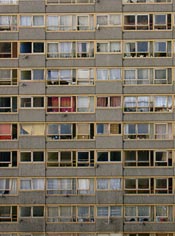
London is rapidly ridding itself of social welfare developments from the 1970s. The city can’t afford the poverty and crime such structures inspire. These architectural monuments to a welfare state have all become fair game, while the notorious Heygate Estate is first on the demolition list.
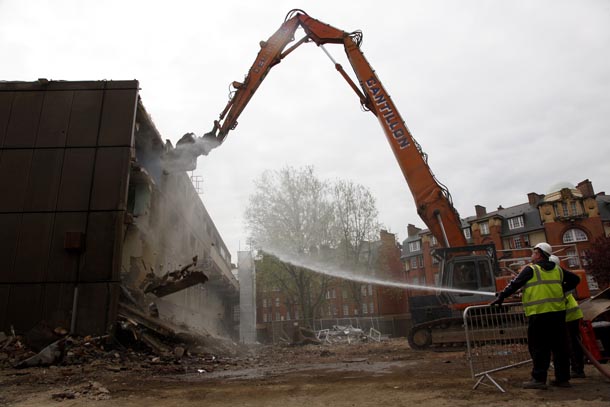
“People just can’t be happy living in a space like this,” is the official reason Heygate Estate, a 1974 structure and example of so-called welfare-construction, was served its demolition papers and its tenants slowly but surely evicted. When the last of the tenants cleared out last week, its demolition commenced.

Heygate originally housed around 3000 people with its 1212 flats. As one of the biggest examples of welfare construction in Great Britain, it was envisioned as a location set to take care of not only the housing issue, but was also anticipated as a place for creating social cohesion that would make social integration for immigrants and their families that much easier.
Tim Tinker, the architect who designed this project in a rush of futuristic inspiration in 1960, envisioned that this Goliath, realized as a mass housing project intended for mostly Asian and African immigrants, would be in function until 2030 at the least. However, it seems that come 2011, functionality isn’t enough anymore. Southwark district, where the estate is located, is going through an in-depth urban renewal, while the proximity of the city center, London’s business district, raises the attractiveness of the location. The Elephant and Castle, the London district where Heygate is situated, was up to now synonymous with concrete bleakness, poverty, crime and inhumane living conditions. This “Brave New World”, i.e. gigantic slabs of concrete that once upon a time emerged enthusiastically as the ideal modern solution to ensure housing for a large number of people, rapidly turned into a “gangster’s paradise” and the biggest function of the Heygate Estate came down to serving as a backdrop for shooting movies about the socially deprived.
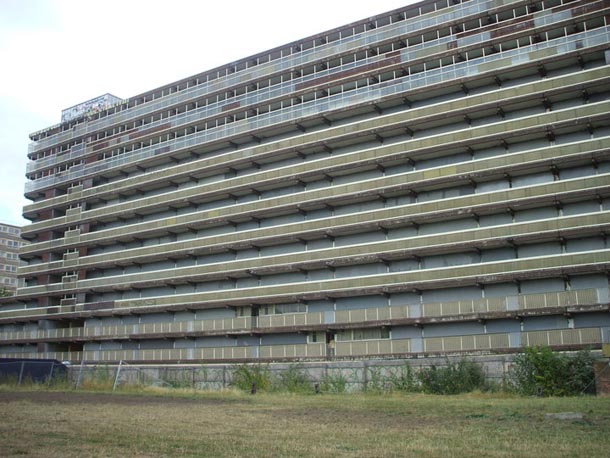
The last in a string of such movies was “Harry Brown” with Michael Caine in the lead, where Heygate served as a location for filming scenes of fighting and drugged-out underage gangs. Clint Eastwood also chose it as the perfect location for his thriller “Hereafter.”
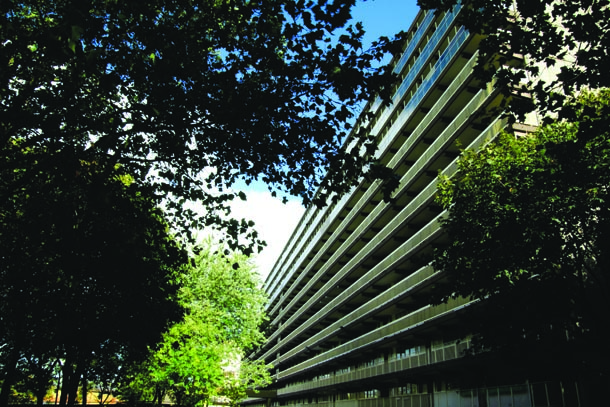
This public image played a key role in bringing the decision that this part of London’s architectural history be rubbed out and swept under the rug as soon as possible. Heygate’s residents, those still remaining in the building, tried to refute this presented stereotypical image through the media. They pointed out that their two-and-three bedroom flats aren’t such dumps actually. This fresh onslaught of massive depopulation gave way to a new sort of social shock, they warned. It all fell on deaf ears.

Local authorities decided to tear down Heygate Estate and went on to sign a £ 1.5 billion contract with the Australian company Lend Lease. The residents got high compensations for moving out, and in time, even the most zealous demolition opposers resigned themselves to the inevitable. Fiona Colley, a local Elephant and Castle councillor and cabinet member for regeneration, dubbed this a monumental project. “Many people in the neighborhood expect what’s coming – the arrival of completely new, safe and cozy homes for everyone.”
A similar fate awaits several other examples of London architecture from the 1970s, such as Robin Hood Gardens, a complex in East London containing 213 flats. Following unsuccessful attempts to put it on the architectural heritage list, Robin Hood Gardens is set to be torn down and replaced with new projects worth 500 million pounds. Aylesbury Estate, yet another Le Corbusier-inspired council estate, a 285.000 square meter structure and the largest housing complex in Europe, is also set to be demolished.
Jasminka Šikić


