


Illegal Tattoo Art Covering Naked Bodies
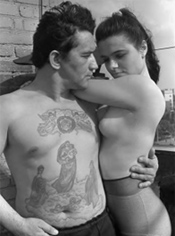

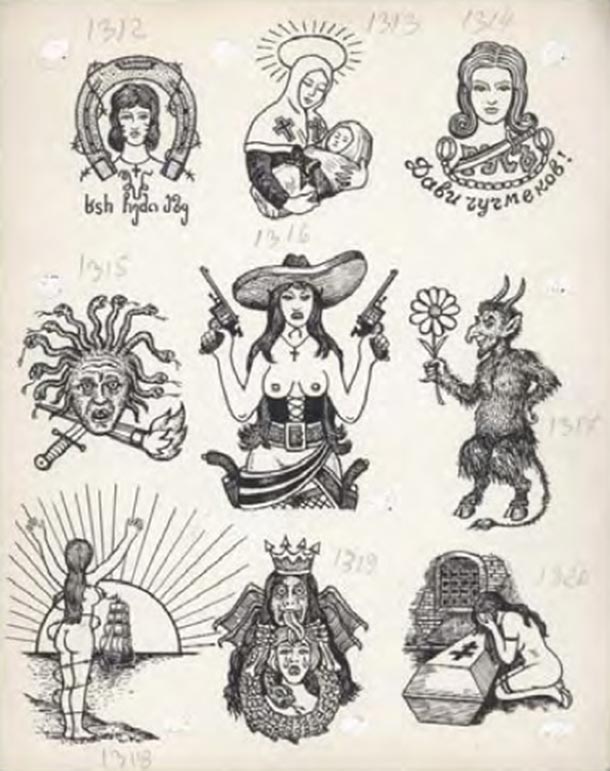
Danzig Baldaev grew up orphaned in Russia in an orphanage for children whose parents, like Danzig’s father, were labeled as ‘enemies of the people’. During the Soviet regime, he lost 58 relatives. After leaving the orphanage he was forced to work as a prison ward in the notorious Leningrad prison, where he worked from 1948 to 1981. He would return to his apartment every night after work, sit at the table and document in drawing criminals’ tattoos, carefully recording the rituals of an extremely closed society. These tattoos are, in fact, full of symbolism and hidden meanings, and describe the complex hierarchy in the gulags. Most of them were anti-Soviet and often utterly obscene.
The KGB showed Baldaev no mercy upon learning of his project: “They fully understood the value of these tattoos and how they could impart all information on a convicted criminal: the date and place of birth, the crimes he committed, where he was imprisoned, along with his psychological profile.” Baldaev died in 2005, leaving the legacy of his life’s work to his widow. Fuel Publishers heard of him by accident and obtained the rights from the widow.
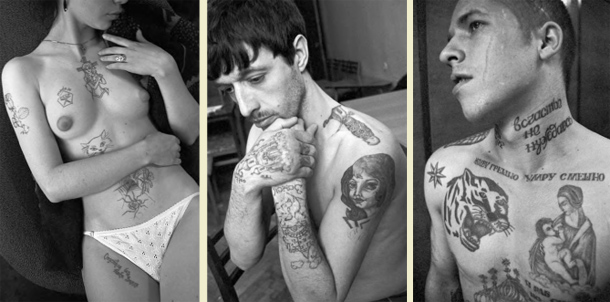
They published the drawings in the book “Russian Criminal Tattoo Encyclopedia,” in three volumes, and will now open the homonymous exhibition at the Gallery 4 Wilkes Street in London. It will, for the first time, present Baldaev’s original drawings, which describe the symbolism in the background: criminals tattooed skulls, thieves, cats, a penis tattooed on a woman meant that she was a prostitute, the number of crosses showed how many times they were in prison…
Tattoos were, of course, illegal in prisons. Beside 120 Baldaev’s original drawings, the exhibition will also present 16 photographs taken by Sergej Vasiljev.

P. S.


