


Kabul’s Cultural and Structural Takeoff?


The constant war siege certainly hasn’t done Afghanistan any favors in view of its economic and cultural takeoff. The Taliban rule, along with considerable American “intervention”, have only brought about catastrophic losses, countless victims and complete disrespect of any and all human rights.
In an attempt to provide a new image of Kabul’s developmental launch in the last few years, The New York Times recently published an interesting article on the local residents’ relationship towards a new/old invention – the elevator, an indicator of cultural and urban development in any given society. An elevator was certainly the last thing inhabitants thought about in their attempt to stay alive, and anyways, until recently the typology of the houses for the most part came down to brick three-story houses where elevators were unnecessary. The six-story building where the ministry’s and the President’s Offices are situated does have an elevator, but it’s chronically out of order. Interesting to note, the population doesn’t even have their own word for “elevator” in the dictionary, the closest term being “bala barenda”, which loosely translates as “a people-lifting-thingy.”

However, Kabul has become an investment hotspot in the past few years, while real estate and land prices have soared by 75 percent. The underlying reason being international agency investments willing to pay for the best locations, as well as well-off Kabulis who got burned during the Dubai financial collapse. Regardless of various developmental limitations, money is still pouring in from drug trafficking (opium), as well as from the so-called “Poppy Palaces”, all of which facilitates a competitive real estate market, which in turn is most clearly reflected in the development of skyscrapers and shopping centers by means of which the path to capitalism is guaranteed.
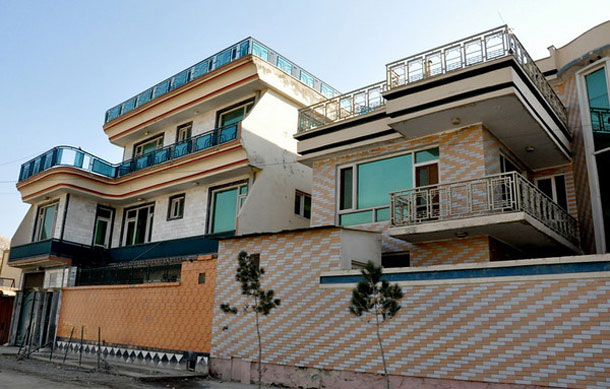
However, there’s still the elevator issue as it thus becomes a necessity in multistory buildings: the biggest impediments to elevators being both the public’s attitude, as most people are scared of elevators, thinking a crash is imminent, and daily electricity blackouts. However, as the local building philosophy favors floors piled up on top of each other (presumably following the Tower of Babylon model), even 13-story skyscrapers often don’t have an elevator, and that will continue to be the case until skeptical investors become aware that it wouldn’t be such a bad idea. For example, the first escalator in Kabul was built in 2005 as part of the Kabul City Center, a hotel and shopping center.

Kabul’s economic development is also visible in the Kabul City of Light Project Proposal to which even President Karzai himself gave blessings to. The Plan anticipates the revitalization of the old city, with emphasis on the quality of life for everyone, not just the privileged.
In that light of advantage and improvement, the story of Skateistan– the first licensed skateboarding school in the world, and in Kabul at that, seems like the promise of a new life. Even back in 2007, Australian skaters Oliver Percovich and Sharna Nolan, decided to open a small skating school, which in two year’s time took on state significance (subsidized by the Afghanistan Olympic Committee!). On over 5000 square feet it became an “all-inclusive” gated skate park. Skateistan really and truly is an embodiment of the spirit of radical Kabul changes: all social classes equal, including all school-age children, with an emphasis on very poor children and girls. A documentary was filmed, while the school holds art and environmental protection workshops.

Not ignoring Russia’s, Britain’s or America’s colonial pretenses, it seems that Afghanistan is slowly but surely gaining the contours of an authentic cultural Middle East domain in its own right.
Fotografije: Architizer; Jacob Simkin ( Skateistan)


