Kapoor’s Olympic Tower Teeters on Verge of Engineering Debacle
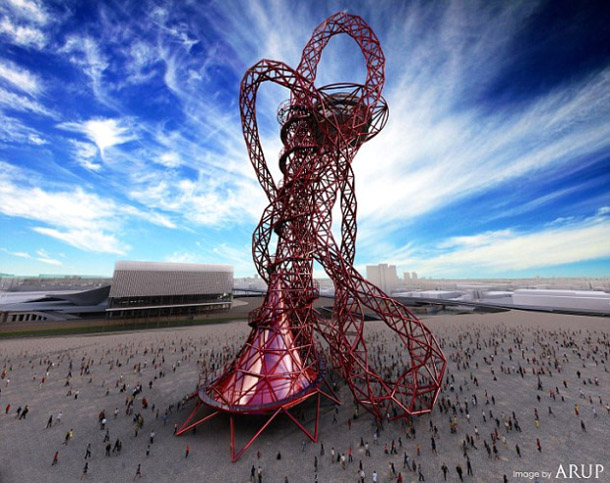
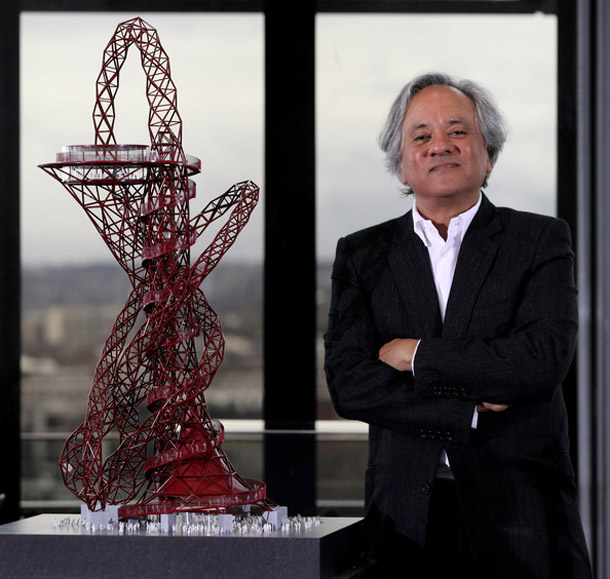
British artist Anish Kapoor won the tender for designing an installation that will symbolize the Olympic Games in London 2012. Under the name ArcelorMittal Orbit, the tower reminds of a death train or some doubled-up crane, and with a height of 115 meters it could easily rival the Eiffel Tower in Paris. The price of this steel structure weighing in at 1.400 tons is 30 million pounds, but the major part of the amount will be paid for by Indian tycoon Lakshmi Mittal, Kapoor’s countryman.
Located next to the giant Olympic Stadium (which is under construction, the end being nowhere in sight), the Tower will include observation booths with a capacity of 600 people daily, and should ultimately become a part of the new London landscape.
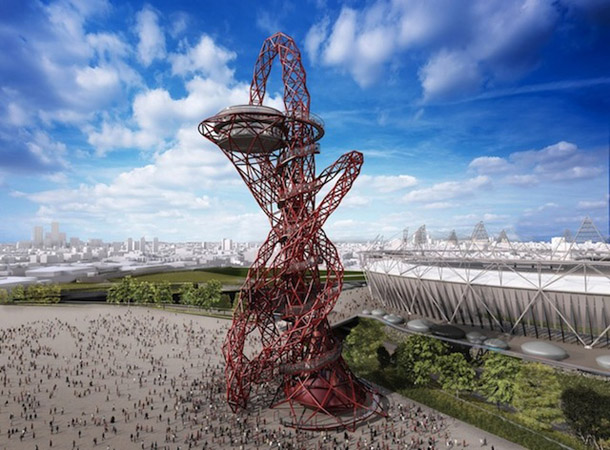
However, just as the construction of this massive edifice started, the Commission for Architecture and the Built Environment (CABE) in London has decreed to submitting the project to a thorough revision to ensure high security requirements are met. Otherwise there will be no construction. They stated that the complex structure lacks organization, and the details are not sufficiently elaborated in the executive plan. Furthermore, it seems that the biggest problem is lack of sewer piping (!), which Kapoor, in collaboration with the engineering firm Arup’s Advanced Geometric Design Unit, did not allow to be included in the project. Thus, requesting Kapoor and his engineering team to completely revise the project with 2012 looming large is no mean feat.
It seems the building inspectors are mostly concerned with the prevalence of the tower which somewhat resembles an unstable scaffolding, and being familiar with the slightly tiring British tendency to safety warnings (of course, for the purpose of their own financial protection), Kapoor has his work cut out for him.
It doesn’t hurt to mention the case of Britain’s currently most popular ‘impossible constructions’ star, Thomas Heatherwick, who faced even bigger problems with his B of the Bang sculpture, set up in Manchester. The large pointed sculpture was the greatest British art installation at the moment of its setup, but an error during its formation caused the collapse of the sculpture axis. The sculpture was removed in 2009, and Heatherwick had to cough up 2.7 million pounds compensation to the city.