


BIG Brings the Little Mermaid to the Expo

The Expo 2010 Shanghai World exhibition and its accompanying architectural infrastructure is one of the most current topics of similar-themed blogs worldwide. We’ve also already covered some of the most interesting Pavilions, e.g. the unfortunate solution of Croatia’s presentation as well as British criticism of the Expo.
The Expo in Shanghai opened its doors on May 1st. Following fireworks and a spectacular celebration, the Pavilions were launched, with thousands of Chinese flocking to the Pavilions frenziedly collecting as many stamps as possible which are obtained upon entry into the colossal structures of any given country. The Croatian Pavilion, as we were informed, doesn’t even have a stamp, hence the employees made an attempt of explaining to visitors in “fluent Chinese” that they can’t get a stamp from their Pavilion.
However, the (un)successfulness of the Croatian presentation at the most important world tourist-cultural fair aside, along with the comments of numerous critics regarding the necessity and pretentiousness of such an exhibition, it’s nevertheless important to stress the fact that in more ways than one, the Expo is a junction du jour of the early 21st century architectural achievements.
As we have already mentioned many times over, we regard the Danish Studio BIG as one of the most architecturally progressive, as we consider Bjarke Ingles, its Head, to be one of the most creative minds in architecture within the last few years.

The much-touted Copenhagen studio, in collaboration with Arup and 2+1, is the author of the Danish Pavilion in Shanghai. They got the opportunity for realizing their concept of an architecturally designed presentation of their country by winning out, among others, two other noted Danish studios –Cebra and 3xn, whose bank project we covered here.
The Danish Pavilion in Shanghai isn’t just a visually attractive design, its concept and realization perfectly capture the Danish spirit, permeated with the unofficial slogan of promoting the country’s ecology and sustainability. The basic form of the facility is a large loop on which visitors can ride one of the 1.500 bicycles provided at the entrance, thus depicting an image of the actual urban Danish lifestyle, alongside the availability and omnipresence of the ecologically-aware mode of transport. A large pool is situated in the center of the rotunda where visitors can go swimming. The particularity of the pool lies within the fact that it is filled with fresh water from one of the cleanest world harbors, of course, the Copenhagen one. For the needs of the Expo even the Little Mermaid, the most famous symbol and trademark of Denmark’s capital, has been temporarily moved to the Pavilion, as it was, in Bjarke Ingels’ words, considerably more resource efficient moving The Little Mermaid to China, than moving 1.3 billion Chinese to Copenhagen.

Considering the indisputable originality of what is probably the most interesting Pavilion, in view of form, theme and programme, the effort that belies marking the importance of the Expo by actually transporting the renowned city symbol to the other end of the world and the fact that Denmark is in size and population similarly equal to Croatia, it is nevertheless hard to console oneself with the fact that the Danish GDP is twice the size of Croatia’s. Every Expo visitor will most probably leave the Shanghai exhibition with twice as stronger an impression regarding BIG’s Pavilion than they will concerning the flag-adorned Croatian Pavilion.
Does the Danish effort speak for itself regarding the treatment of the Expo, hence the inadvertent comparison to the Croatian “case”, i.e. the Croatian Pavilion in Shanghai, and Croatia’s incorrigible blunder of not paying enough respect to the event, followed by the insufficient media coverage of the topic in Croatia; or are flags, oil, cheese and Pag lace all that we have and should thus offer to the world?

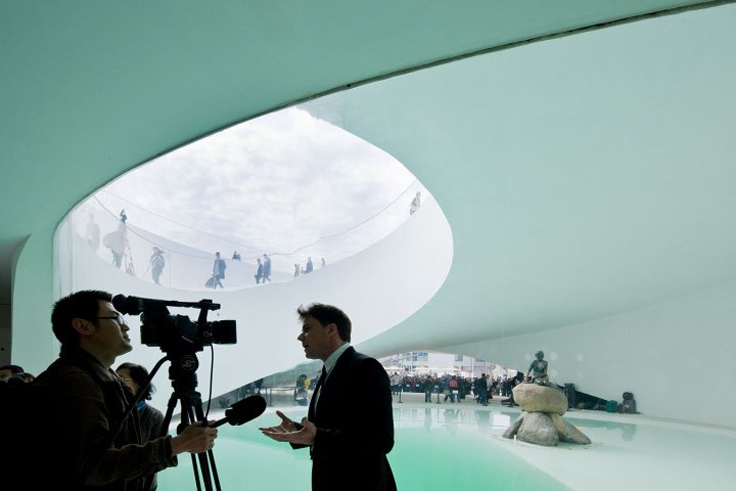


Photography: Iwan Baan
For more information on the Danish Pavilion click here


