


Genius Loci vs. Zeitgeist

Days of Oris report by Petra Tomljanović

Yet another “Days of Oris” have ended. At their tenth anniversary jubilee, many excellent lecturers filled the packed Vatroslav Lisinski Large Hall. This year the emphasis was on the most important realizations among world architectural productions. To list but a few must-mentions: the lectures of Paul David, a Portuguese architect whose boundless sea horizons have become the leitmotif of his houses, as spaces of meditation and reflection, followed by the Spaniard Francisco Mangado with a charismatic presentation of his designing statement alongside his other interesting remarks on contemplations of architecture and space. The accompanying program included book promotions, an exhibition for tendered works for the “Paromlin” as well as three film showings. However, the most inspiring part of “Days of Oris” probably belongs to two architects, whose discourse, while radically different, is nevertheless contrapuntal.
The architects in question are Peter Zumthor and Wolf D. Prix (the founder of Coop Himelb(l)au), whose lectures marked the beginning and end of the first day.

* Peter Zumthor * Wolf D. Prix
Peter Zumthor, a Swiss architect of a somewhat monastic character, is the winner of the 2009 Pritzker Architecture Prize. His most famous projects include a complex of thermal resorts in the Swiss Vals, Kunsthaus in Bregenz and the reconstruction and interpolation of the Dioceses of Colombo Museum in Köln. He was also selected as the next designer of the Serpentine Gallery Pavilion. Zumthor doesn’t have many built projects under his belt, mostly due to his lengthy contemplation over every detail and control during the development process. In addition to perfectionism, which is closely tied to Swiss pragmatism and endless consistency in material selection, Zumthor, like no other architect, at the same time possesses a poetic character of almost mythical proportions, expressed in the importance he places on the ambience pervading his houses: he emphasized togetherness among people, spaces and things at the lecture, pointing out the importance of the way in which people observe spaces, how they smell them, feel them – almost a Proustian synesthesia!
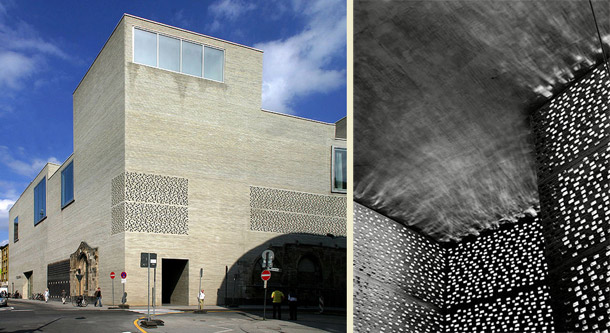
*Kolumba / Koeln, Njemačka

* Terme Vals / Vals, Švicarska
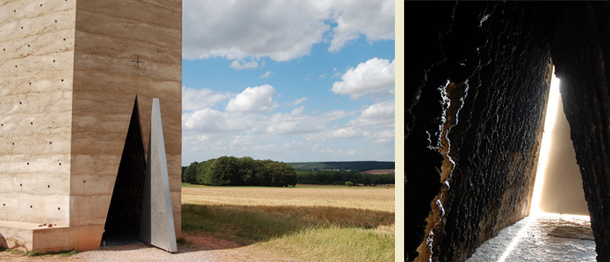
* Bruder Klaus kapelica / Wachendorf, Njemačka
We could rightly dub Zumthor a genius loci architect, with reference to Schultz’s definition of a certain context that also generates architecture, which is visible in his use of local materials or traditional building techniques. Zumthor truly attaches significant importance to the context in which he is creating, for the most part presenting new projects that are under construction or in their conceptual stage. Under the common denominator “A Sense of Belonging”, Zumthor confined himself to smaller-scale projects (aside from the Columbus Museum and the LACMA Museum in Los Angeles), but of exceptionally strong energy: St. Klaus’ Chapel, a hotel in the Atacama Desert in Chile, a vacation house based on Alain de Botton’s idea, a Zinc Mine Museum in Norway, and a completely compelling monument to witches burned at the stake in the Norwegian town of Varanger.

*Memorial to the Burning of Witches, Vardø, Norveška
This last project, in collaboration with the one-of-a-kind Louise Bourgeois, precisely showed the full poetic nature of Zumthor’s line of thought: how to commemorate, how to convey the ambience of the inquisition’s horror, by using silk fabric as walls, flood-deposited wood and traditional Norway structure for drying herrings as carriers for the 125-meter long and approximately 1.5 meters wide edifice. His architecture clearly shows it isn’t a mere epitome of our time but genuinely timeless.
On the other hand, the lecture by the great Wolf D. Prix, the pioneer of deconstruction and the head of Coop Himmelb(l)au Office in Vienna, offered an entirely different perspective on society and architecture. Their hi-tech buildings such as the BMW Headquarters in Munich or the European Culture Forum are true apologists of today’s society. They might even be modern seats of power (or at least seats of money) that Prix himself compared to the concept of a Greek temple.

*BMW centar / Muenchen, Njemačka

* Solarni krov / Perugia, Italija

* Paviljon 21 Mini Opera Space / Muenchen, Njemačka
Although they base their concepts on natural forces, i.e. phenomena such as cyclones or synapses, this organic foundation is combined with modern technology and processes such as scripting, to achieve an out-of-this-world appearance and the possibility of existence in real space. Coop Himmelb(l)au advocates rethinking urbanism and emphasizes energy efficiency of buildings, especially when it comes to redefining the idea of roofs that can no longer serve just as protective top layers. They believe it’s necessary to develop new approaches to designing roofs, as was done with the energy roof for Perugia’s pedestrian zone, or the vortex roof of the BMW Headquarters which serves as a place where people can meet under the sun. Buildings that strive to function as “the ultimate machines” are perfectly in-sync with today’s social order. They are pure Zeitgeist. Finally, Prix rounded up his lecture with the presentation of the pavilion for the Munich Opera Festival, concluding that architecture falls under many influences, and in this case, “it follows music”. The polarity between genius loci and Zeitgeist, although present since the 18th century, continues to incite debate in architecture today. Certainly, both concepts merit metacritical and metaphysical approaches to understanding, while actual work by both architects shows society’s (late) postmodern character.


