Ships Aren’t Just For Sailing!


For the second consecutive year the shipyard in Lošinj reveals its hidden potential by opening its doors to artists. The reason for this is, of course, the ŠKVER! Festival which took place from June 27 to July 3. It managed to successfully stand out thanks to its concept and quality.

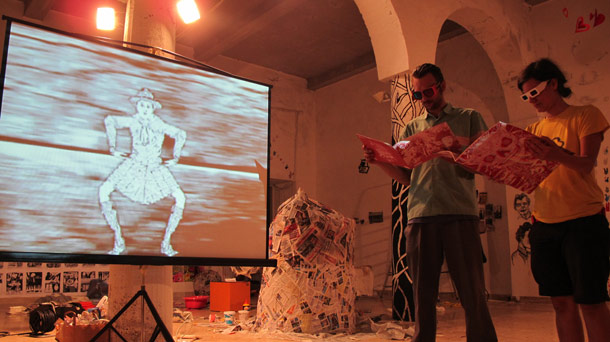
One of the ideas of the Festival is the popularization of a different kind of presentation of artworks as opposed to the classical gallery-style approach, as well as the wish to surprise the audience and get them to react. This also opens up the possibility for the authors to work in unconventional and inspiring areas of the industrial facility. The shipyard becomes an improvised gallery where any and all types of artistic interventions are allowed resulting in creation of interesting contrasts in an industrial area.
As “the industrial oasis” the shipyard had the main role at the Festival in terms of inspiration, stage, and fertile ground for artistic actions and reactions.
This year’s Škver doubled in the number of visiting artists and an additional space was needed. It was found at the Kvarner Palace in the city’s center with the aim of including the local community in the free program of the Festival.

Some 20 domestic and international artists took part in the Festival: Igor Hofbauer, Ivana Armanini, Vana Gačina, Dunja Janković, Iva Šulović, Igor Bezinović, Vančo Rebac, Matija Kralj, Marija Lopac, Josip Bolonić Sergej Vutuc, Mileta Mijatović, Ivana Zubović, Željka Blakšić, Tanja Minarik. And the international authors that came to Lošinj were: a director from L.A. Ryan Jeffery, comic-book author Austin English, painters from Sweden Clara Bessijelle Johansson and Anna Ehrlemark, Bosnian author Emir Šehanović, collective Komikaze and French-Serbian collective Turbocomix, and also festivals: Floating World Animation Festival (Portland, OR) and NOVO DOBA (Belgrade).

The area of the Kvarner Palace was open during the Festival, effectively functioning as the city’s atelier. A number of exhibitions was put up (Komikaze collective, Plem Plem cultural center from Heilbronn); also free workshops were given (linocut, silk-screen, lamination, and how to make photographs in the darkroom).
Various shows were on the program every night (experimental films by Dalibora Barića, the Floating World animation festival, films about Croatian shipyards), as well as presentations of art projects.
The shipyard’s doors were open to passers-by and visitors in order to enable them to grasp the creative atmosphere of socializing and creation at the shipyard and on the spot alike.

The idea was to design and present the work of an independent art scene that the island lacks. Inside the shipyard some ten artist were drawing murals, making installations, relief, and sculptures; photographs were taken and films made. The artists were creating after the shipyard’s working hours and well into the night.
This year’s novelty was the direct collaboration between the artists and the shipyard workers.
A short documentary about the shipyard was made by the workers themselves and under the guidance of Igor Bezinović. The documentary was edited and presented at a special showing at the shipyard’s canteen. Also, one of the workers, inspired by an iron sculpture of an art workshop participant, Matija Kralj, made a sculpture of his wife from scrap-iron.

The last day of the Festival offered the Shipyard’s Open Doors where all visitors were given the chance to walk around the shipyard and see what is being done.
At the Shipyard’s entrance the documentary made at the Festival was shown and the workers also threw a ‘wrap-up party’ for all the participants and visitors, which marked the end of this year’s ŠKVER! festival.