


Tolerance is a Serious Architectural Issue


Last year’s GONG research on today’s youth, carried out in senior classes throughout 43 Croatian High Schools, showed worrisome results in view of today’s youth’s attitudes towards diversity in society. Thus 40 percent of them hold that Croats in Croatia should have more rights than members of other nationalities, and the same number of them thinks that the Republic of Croatia should be defined solely as a national state consisting of only people with Croatian nationality all of which should be regulated by the Constitution. A whopping 47 percent of them consider homosexuality to be a disease, implying that in addition to hostility, they’re also demonstrating resistance towards scientific facts, while 40 percent are so radical they hold homosexuals should be banned from any and all public appearances.
It’s unknown how Split high-school students rated in this study, however, Split isn’t exactly the ideal place one wouldn’t wish to test any way, shape or form of “different”. Split seems to revel in poking fun at anyone and everything that seem to leap from the standard of a (petty) bourgeois environment, while it has also been known to send even more dangerous messages than mere mockery. The Split Mayor Željko Kerum made an announcement, using public television as his platform, how he wouldn’t want to welcome a Serb in the family, while a “Serbs on Willows” sign (Croatian slogan calling for hanging of Serbs) suddenly appeared in the city center, right in the middle of last year’s tourist season. The threatening comments that have been accompanying the announcement of the first Gay Pride in Split in June should also not be taken lightly. Hajduk fans just recently voiced their unconditional love towards the century-old football club loudly by occupying the waterfront (whose renovation a few years back was also met with fierce attacks, the arguments against the new project insinuating the designers, not being from Split, didn’t and, in effect, couldn’t understand the significance of this urban space), however, the right to express one’s love towards the same sex should be confined to the privacy inside four walls. Due to all these reasons and because of a whole other series of intense socially-charged relations, Split is just the place to enforce and insist on issues such as pluralism, democracy, dialogue, tolerance, openness…

What kind of a role can and does architecture play in the promotion of tolerance? A significant one to be sure, as there are plenty of examples showing that architecture, primarily through various programs, successfully generates tolerance (let’s take a look at just this one little example: in De Baarsjes, a multicultural Amsterdam district, where immigrants from over 120 countries reside, the local government decided to build a Sports Center to improve the social life and increase social contacts among the residents). There are also some absurd examples as well, such as the idea to build the Israeli Museum of Tolerance in Jerusalem, which precisely has promotion of tolerance and understanding between different religions as its main goal to, on the site of a one-time Muslim cemetery.
The “House of Tolerance” workshop, initiated by the Split Faculty of Civil Engineering and Architecture, has showed how architecture students have risen to the challenge of this extremely interesting topic of tolerance. Within the framework of the Architectural Design 8 course, the workshop lasted throughout the entire semester, and had been announced by Hrvoje Njirić, a FCEA professor, at last year’s SplitTalks. Fellow Split architects and lecturers Emil Šverko and Saša Begović headed the workshop along with Njirić, while the works were evaluated by a writer-architectural-entertainment panel of judges Zlatko Gall, Ante Tomić, Damir Rako and Zlatan Stipišić Gibonni who the week before last decided on the most successful works at a two-day show of presentations. 26 students, divided into 14 teams, participated, as was noted by architect Dujmo Žižić, who was an assistant professor at the workshop. All teams chose different, largely inarticulate, incomplete or neglected Split sites – at least judging by the best ones – and these different parts of the city carried values of varied political, cultural, and zoning systems.
As far as the topic itself, tolerance can, of course, be very broadly comprehended and architecturally interpreted, while the authors of the selected works mainly focused on tolerance which encourages the coexistence of different users of any given space or tolerance between the old and the new, as in the case of the Pazar (Market) and Diocletian’s Palace. However, some students dealt with some of the most sensitive city issues so the War Museum located in the Lora (a dark place within Split’s recent history) could also be found among the works, as well as the “Save Women House”, where the idea was that violent domestic offenders would be rehabilitated on the city’s outskirts, instead of the victims having to leave their home as is the current practice.
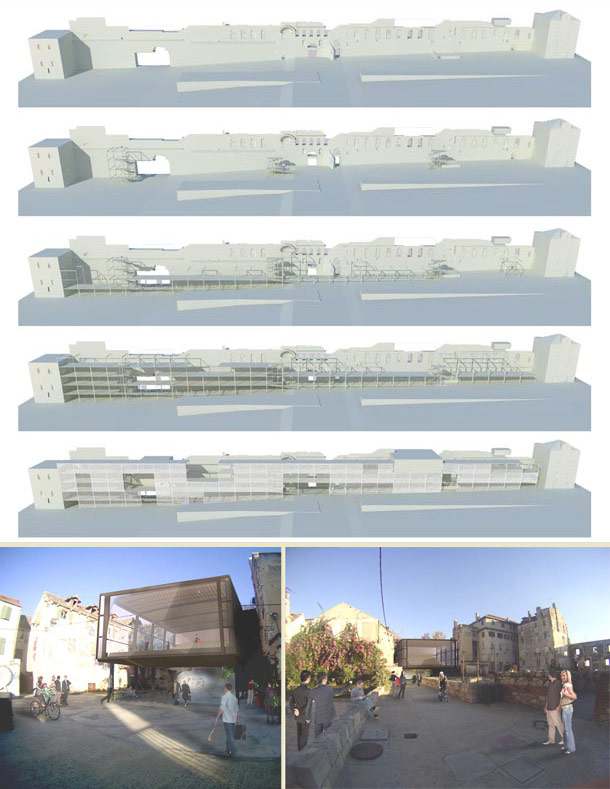
* Katarina Kovačić & Stjepan Miketek
Six works were evaluated as either excellent (4) or very good (2). The work of students Katarina Kovačić and Stjepan Miketek was particularly noted which the Faculty of Civil Engineering and Architecture will propose to the City as a project worth carrying out. It is a simple and temporarily assembled construction in Hrvoje Street, right next to the walls of Diocletian’s palace, where the Pazar (Market) has spilled over along its entire length and is consequently crawling with market stalls. The construction would be placed between the northeast and southeast tower during the archeological excavations planned there. This steel and stamisol construction would “host” various content on its facade – a relocated part of the market, a tourist info center, restaurants, an archaeological workshop, a gift shop…, while climbing the walls of the Palace would be made possible at two places, which is otherwise impossible. After dismantling the structure, the material could be reused in the shipyard. The structure itself could be financed by ads on its facade. The students also propose two permanent facilities – auditoriums, one of which would face the southeast quadrant of the Palace, and the other which would be a sort of an extension of the Emanuel Vidović Galleries.

* Frane Dumandžić & Luka Petričević
Students Frane Dumandžić and Luka Petričević hold that tolerance can be achieved by a relationship of mutual interest and control among various users, dubbed as the Big Brother effect. Their “Big Brother House” on the Hrvatske Bratske Zajednice Square (Croatian Fraternal Union Square) (which is called a square only formally, as it’s really a parking lot between the courthouse and the prison in Split) has highly colorful residents: there’s the city administration, the prison, housing, a hostel, a shopping center and the building is open to passers-by since it’s connected with a metro station, which is planned here for some distant future date.

* Domagoj Diklić & Tonia Prančić
Domagoj Diklić and Tonia Prančić are also authors of an excellently evaluated work, which anticipates varied content: they suggest a PET-packaging recycling factory along with design workshops, housing and retail outlets, all of which would be situated at the current city center parking lot, just over the intersection of the railroad tracks and near the Pazar (Market).

* Bruna Kovačević & Mirjana Radoš
While the last two decades of various developments have been progressively swallowing up the Split Marjan, students Bruna Kovačević and Mirjana Radoš are set to expand the Marjan by lowering the vegetation all the way down to the old Hajduk stadium. Their idea is to arrange a garage, a drive-in landfill, a cultural center and other public facilities along with a hostel at the underground floor level, while greenery with recreational facilities would be situated on the ground floor.
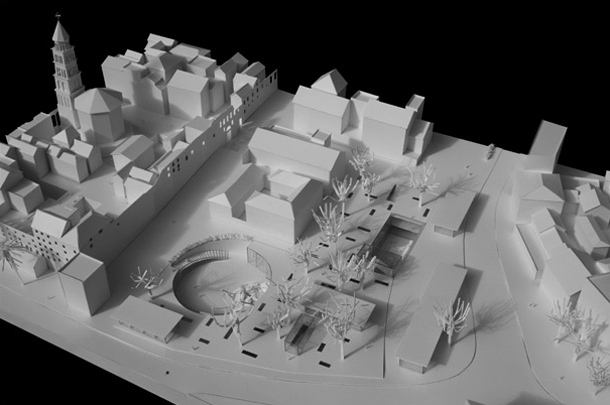
* Ivana Kujundžić & Mia Mandušić
Ivana Kujundžić and Mia Mandušić are the authors of a work evaluated as ‘very good’: they present the supposed archaeological findings in the area of today’s Pazar (Market) on two underground floors, alongside restaurants, cultural and recreational amenities.

* Martina Jerončić & Ana Tešija
Martina Jerončić and Ana Tešija are also in the ‘very good’ category. They developed a membrane of public and cultural facilities and a rehabilitation center for addicts around the existing core of the Youth Center.


