


“The Most Important Thing is My Models Be Inspiring!”
A revolutionary turn-about in fashion photography ensued when Terry Jones, a designer and former Vogue art director, founded the i-D Magazine in 1980. Costly editorial productions that included an army of stylists, models and photographers which put designer clothes at the center were then replaced by esthetically hand-woven fanzines, texts written with a typing machine while a drastically changed attitude towards photography also took place as a consequence. Jones introduced a hybrid style of documentary-fashion photography simply called “straight up”, which displayed British youth’s street culture – members of the punk and new wave movements, photographed by the nearby wall, devoid of any glamour. Final photos showed “models” caught from head to toe, facing the camera, while the i-D photo base gradually started shifting towards an eclectic archive of documentary photographs of youth subculture. The entwinement with high fashion started to develop gradually, and that attitude towards fashion created a whole series of young iconoclastic photographers such as the now world-renowned names: Juergen Teller, Nigel Shafran, Corinne Day, Ellen von Unwerth…
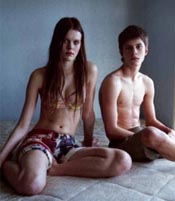
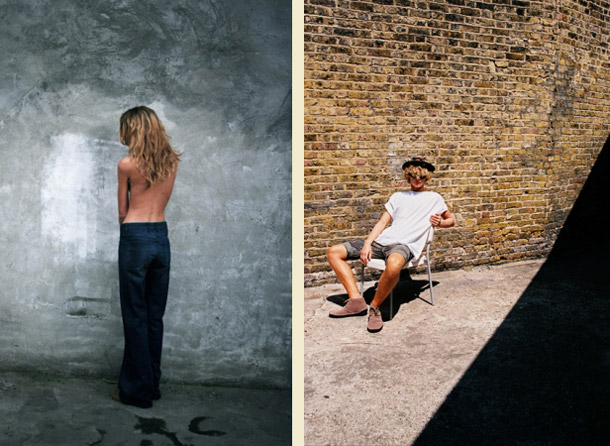
Thus, viewing the artistic expression of young Split photographer Bruna Kazinoti shows how such a radical break-up left its mark on fashion photography and to what extent it’s actually still current – viewed through a strong, individual photo signature. We talked with Bruna about her artistic expression which pays homage to the nineties’ poetry, analog photography, male models… We interviewed her just in time for her first Zagreb exhibition at the KIC Gallery. The exhibition entitled Magazines is a selection of her editorials captured for the following foreign magazines: Hero, POP and Intersection in the past year.
For the most part, your work is tied to foreign magazines. Could you describe how your collaborations with them started?
During my senior year at college I made a series of photos that I sent out to magazines I liked. The stylist and editor of the magazine Dazed&Confused, Katie Shillingford, liked the series and offered me a collaboration. Following the editorials at Dazed, other magazines started to call me… And that’s how it all started.
Do you think that your talent is appreciated and recognized in Croatia? To what extent does your esthetic correspond with the current domestic production, both fashion and photography-wise?
I think my talent is recognized and appreciated in Croatia. However, as my photography and fashion expression differ from the current Croatian (popular) artistic expression, there aren’t many people who are open for collaboration with me. I don’t think that should be viewed as an obstacle though, as it’s interesting to see various expressions and directions in photography and fashion.
You nurture an artistic expression that leans toward punk, the neo-romantic, documentary, assuming natural light, what’s pretty far removed from the glossy fashion photography that we see in the majority of magazines. Could your esthetic be perceived as a subversion in the face of such mainstream photography?
In Croatia, yes.

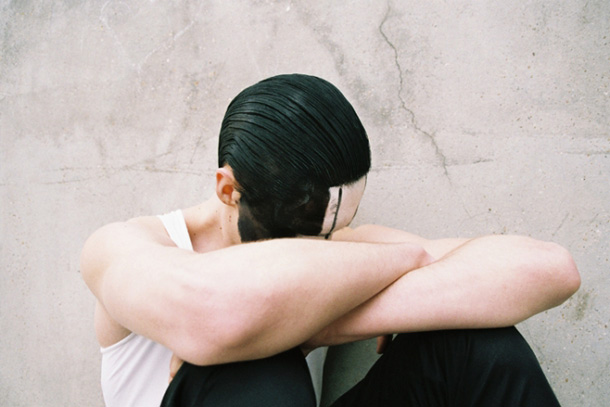
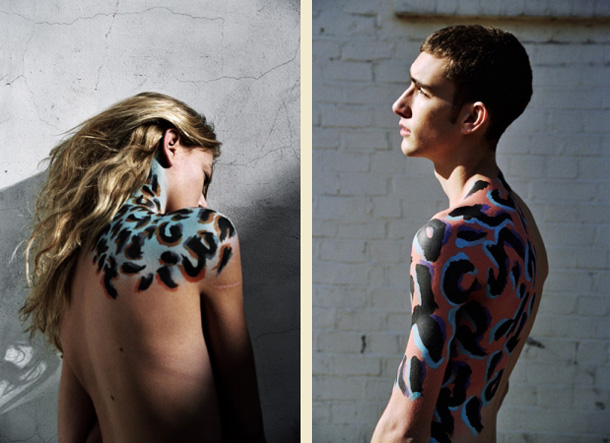
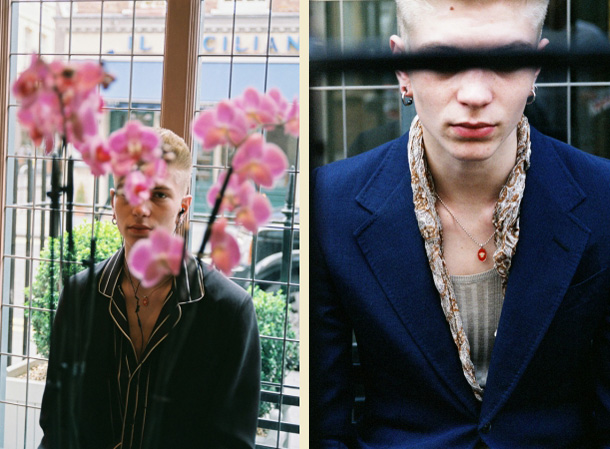
We only saw male models at the KIC exhibition, and in portrait form, at that. The models are quite androgynous and don’t embody the hetero-normal stereotype of the male body. Do you have a particular inclination towards those types of models, how do you pick them, anyway?
I choose my models based on the type of shoot, that is, the idea behind the shoot itself that the stylist and I want to achieve. For me the most important thing is that all my models be inspiring. If I don’t like a model, the shoot won’t go well.
How do you strike a balance between the client’s desires and your own ideas while creating an editorial? How much are you willing to compromise? For example, when you’re asked to endorse a brand in an advertisement…
For the most part, I do editorials the way I want to. When magazines invite you for collaborations, they want your esthetic and you do what you want. Shooting campaigns and ads is completely different from editorials and I don’t mind compromise and cooperation in this segment. Then again, if someone invites you to shoot for them, they’re clearly acquainted with your artistic expression and work.
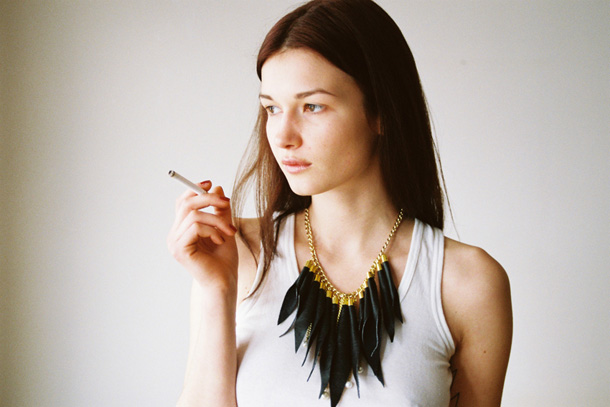
You’re not really inclined toward digital photography, and I’ve noticed that in today’s digital era, analog photography is making a comeback. It seems that it embodies a sort of “desire for the authentic, imperfect” that’s been lost with photoshop. What are your experiences, has this become a mainstream trend? It’s a fact that production-wise analog photography is a lot more expensive – time and financial-wise, and there’s small margin for error…
I’ve been using analog photography forever. I tried digital photography once and it just didn’t sit well with me. The whole shooting process is different, as is the quality of the ultimate photograph… production-wise, analog photography is more expensive, but magazines that like your work respect your way of working. Time-wise, it sets you back for just a day, so that’s acceptable by any standards. And I especially like it because it leaves virtually no margin for error.
Do you make a distinction between fashion and art photography?
No.
You went to the Royal Academy in Antwerp. Why did you choose Belgium – did you get the education you wanted?
The Royal Academy of Fine Arts in Antwerp is one of the most well-know academies in fashion. Also, they offered a four-year course in photography with lectures in English. That was a good combination for me. There are always things I would change, but, in the end, I think that what matters most is who you are.
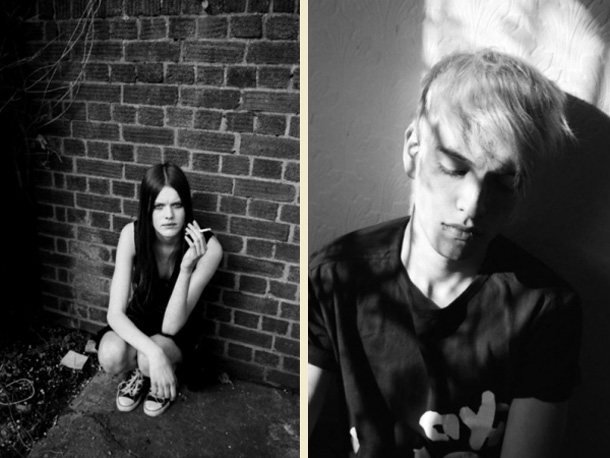
Which magazines or models would you like to work with? What photographers and artist do you admire?
I like Self Service, Purple, and many other famous magazines. I’d like to work with them, but I’d also like to work with some new magazines. I like it when new magazines appear on the market, with good production, good look, and good people. I like new, young models.
The exhibition at the KIC Gallery is open until May 30th, while you can click here to check out Bruna’s work.


