


A New Kind of Postcard from Madrid

Last week, on April 15, 2011 in Madrid, following years-long urban planning, an architectural-town planning competition, huge infrastructure undertakings and years-long developments, the mayor of Madrid Alberto Ruiz-Gallardón opened the last stage of the realized Madrid Río project for the public.
This project was initiated back in 2004 with the goal of integrating the Manzanares River into the city structure. Dating back to the Middle Ages up until recently, the Manzanares was situated on the outskirts of the urban structures, serving as a natural defense barrier, an open wash-space, or, as was the case from the nineteen-seventies to recently – a traffic corridor.
This was what was causing the inability to access the river and what kept it from using its town-planning and atmospheric potential, which was especially important in recent years in view of the rapid developments and renovation of Spain’s capital.

*Plan – Madrid Río
In order to free up the riverbanks, the city anticipated the denivelation of one of its traffic lifelines – the belt highway M-30. Considering that broad-profile roads were being dug in by the riverbed itself at a 7 kilometer length, the operation was longstanding and resulted in building the biggest city tunnel in Europe. For that matter, this was the most expensive and complex undertaking within the entire project and made up 90% of expenses of the staggering amount of 4 billion and a 100 million Euro!

*Parque de Arganzuela
An international architectural/town-planning competition was released for meeting the prerequisites for recuperation of the massive territory. The first prize went to a team headed by Madrid architects Burgos y Garrido in collaboration with the Spanish architectural offices of Porras y La Casta, Rubio y Álvarez Sala along with the Dutch West 8, for their project which you can view here. As the panel of judges pointed out, this project won due to the fact that the green zones, atmospheric and cultural values are best articulated here and also because it has functional, technical, social and economic sustainability. Honorable mentions went to the architects Herzog and de Meuron, Spaniard Juan Navarro Baldeweg and Frenchman Dominique Perrault.
Here’s a video clip if you want to take a look at what the winning project looks like in simulation
The numbers following realization are, as expected, impressive, not only within the Croatian context, but the Spanish one as well, from the aforementioned expenditures to the total surface area amount which is 820 ha. 42 km of new pedestrian and 30 km of new bicycle trails, 11 new pedestrian bridges have been created. Within the framework of the landscape, the designers planted over 26.000 new trees and several hundred thousand bushes and bush-like plants, 85 different types in total.

*Puente de Segovia – Construction site

*Puente de Segovia – The Completed Stage
In its new bilingual brochure the city zealously listed and published all the new attractions, bridges, playgrounds, parks, gazebos and other sights, with an accompanying map which is currently being distributed to all visitors, and you can click here to take at look at it.
The consequences are visible even now, shortly after opening the first stages of the linear park. The citizens of Madrid, who have up to now felt a lack of big open green spaces, hurriedly flocked to the new city oasis. Apartment prices on the right riverbank have doubled despite the Spanish real estate market crisis. However, the problem of entwining two seemingly similar although socially, economically and urbanistically -programmatically different banks, still remains. While the left consists of a distinctly consolidated and homogenous city structure, the right is prevalent with a more heterogeneous program, numerous city cemeteries, large, unprogrammed park surfaces and for the most part immigrant neighborhoods. The Madrid Río Project should include within its ambitious city strategy the consolidation of that zone as well, especially by renovating the housing foundation by implementing elevators in facilities that are without elevators as well as re-facading, including insulation and carpentry for the purpose of achieving improved energy efficiency. Projections and city planners’ analyses show tens of thousands of apartments that require some form of renovation, the average cost being 12.000 Euro per apartment. Of course, the city will participate with covering over 50% in co-financing the expenses, but considering the magnitude of this “beautifying” process and the depletion of the city’s treasury after the undertakings on the river, this seems to be a costly and long-term project.

*Puente de Toledo – Construction site

*Puente de Toledo – The Completed Stage
Criticism of the project has mainly been down to the execution details such as an excessive use of granite or has assumed political connotations with criticism aimed at the costs which are running high. Furthermore, the government and opposition have been trading barbs in view of opening various stages of the project just in time for elections, as is the case now, considering that elections in Madrid are imminent. Although the mayor Gallardón states that there won’t be any problems with the repayment of the project, it’s anticipated that it will last 35 years.
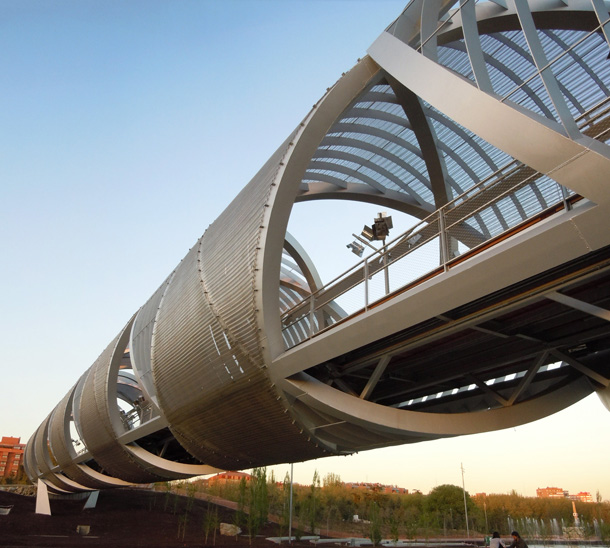
*Perrault – The Arganzüela Bridge
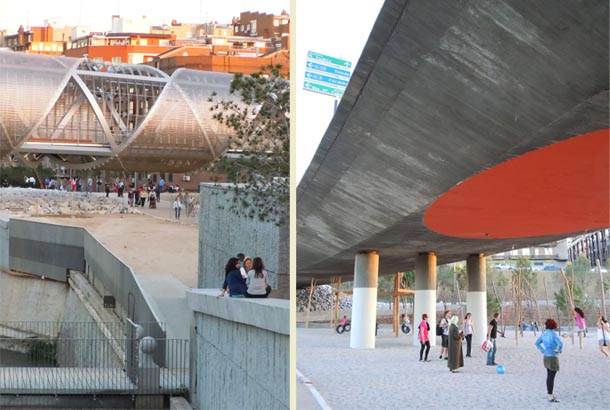
*Perrault – The Bridge Arganzüela *Manzanares – under the bridge

*Manzanares
And while Madrid is wrestling with its city public debt and opening its newly devised river, citizens of Zagreb will be repaying their city debt, while similar projects in view of the Sava River will remain but a Utopia, forever stuck at the theoretical competition level, the competitions being released every ten years or so, or every so often when election year rolls around.

*Puente y – The view from the park facing west
Photographs: www.madrid.es i Damir Sekulić
Damir Sekulić


