


Expo – Expensive and Hypocritical Competition of National Strengths
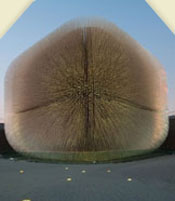
The Expo 2010 opened on Saturday, May 1 in Shanghai. We have already written about the pavilion that we represented ourselves with in China, and gave an overview of some of the more bizarre and interesting pavilions of other countries. The British pavilion, designed by London-based architects from Heatherwick Studio was announced as one of the most attractive, and the British Guardian recently published an interesting comment of both the British appearance and the Expo itself.
The Guardian’s critic Rowan Moore writes that he hopes world fairs such as the Expo will finally die out, as they are insanely expensive and extravagant excuses for national and commercial posturing. Moreover, they hypocritically propose certain topics such as “Humankind – Nature – Technology” or “Love the Earth”, despite being next to nothing in view of sustainability and ecology in the temporary pavilions for which millions of dollars were spent, and millions of visitors’ airplane flights pollute the air space. Moore compares such fair exhibitions to the Olympic Games, which also proclaim sustainability, while in actuality generate debts and invest into development at the expense of the impoverished.

Moore even cites that the Shanghai Expo 2010 will cost twice as much as the Olympic Games in Beijing.
In regard to the British presentation in Shanghai, Moore writes that the British Government desires to nurture good relations with China, as does everyone else, so they didn’t want to rain on their parade with just any old run-of-the-mill pavilion, rather present Great Britain as a modern and creative country, not just the land of Harry Potter or a place of perpetual fog and bowler hats, as the Chinese insist on perceiving it.

They found an appropriate solution in the idea of Thomas Heatherwick, who promised to make Great Britain the star of this year’s Expo, which was also confirmed by the surveys in China, according to which the design of the British pavilion was second only to the Chinese.
Heatherwick’s pavilion reminds the Guardian critic of a head of hair, a dandelion in seed, or a hedgehog. ”As we expected the building to be neither hairy nor in motion, these qualities grant the pavilion a certain charm”, writes Moore. The pavilion lies on a large plane, envisioned as a gathering place for visitors and events, while the main effect can be experienced even without queuing to enter, as its external design is its most important feature. The pavilion does not rely on impressive video projections on the British culture, rather plays with the visual impact, which is a completely opposite conception to our pavilion – in which entrance is a necessity in order to experience anything, the irony lying in the appearance of our pavilion which offers weak motivation to take a peek inside.

Click here to read the entire text
Video from the british pavilion
httpv://www.youtube.com/watch?v=Ls1ChkK40sw


