Space Elevator

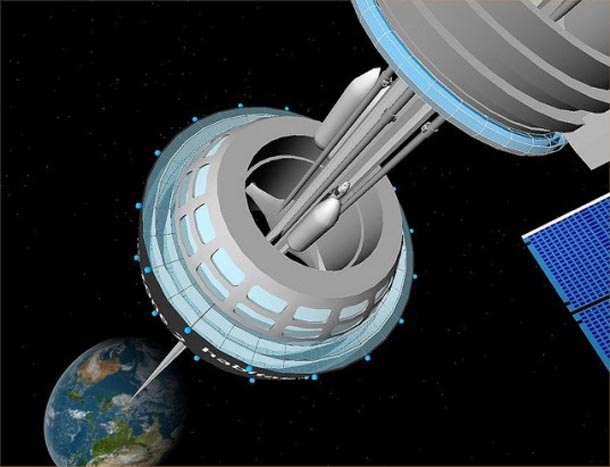
Generations of science-fiction novel writers as well as numerous scientists have been dreaming about a new mode of transportation for years now – the space elevator – that would replace launching pads and expensive spacecraft. The elevator would, without the cost and environmental impact of rocket fueled launches, transport satellites and shuttles into space consisting of a tether that would on one end be fastened to Earth while its other end would freely float in space reaching over 38.000 km. The idea has always been more science fiction than science fact, but according to the latest research from King’s College in London it should be realized shortly.

The idea of launching an elevator into space has been around for some decades now and was popularized by Arthur C. Clarke, the science fiction writer, in his 1979 book “The Fountains of Paradise”. However the idea was never practical because there was no cable strong enough to support its own weight over the huge distance necessary to reach from Earth to space. Before him, the following Russian scientists engaged in similar research: Konstantin Tsiolkovsky (who was inspired by the Eiffel Tower in Paris) in 1895 and Yuri N. Artsutanov in 1959.
Even if constructed, such a cable would need to be kept under tension by the forces of gravity and outward centrifugal acceleration. In theory, the counterweight, which would keep the whole thing stable, would be a docking and refueling station for future space missions. The main problem of the whole concept of a space elevator is the tether. Hence, the problem was developing a cable light yet sturdy enough to withhold the weight of the cargo it’s supposed to transport, and its own weight as well, because of the extreme length. Thus space elevator designers are looking to carbon nanotubes as a modern material with tremendous potential. While they are less than 1/50.000 the width of a hair, when wound together a string the width of a sewing thread could hold the weight of a car. In theory, it could support the 30 tons per square millimeter needed to construct such an incredible system. Carbon nanotubes are still under development but they are the first material we have seen that could be strong enough for this task!
To prove that this isn’t something merely within the scope of scientific theory, it’s important to note that NASA has offered to provide $3 million over the next five years to research the idea and is working on scale models in view of the big launch which could change all our daily lives in the near future.