


The MSU Presents Frameworks Without Borders

If you’re one of those people who will herd along with a river of other visitors to the Museums tomorrow, rather than any other day of the year, we suggest you definitely visit the Museum of Contemporary Art.
building in New Zagreb and witness the indescribable crowds that are inevitable to come in droves tomorrow, as visitors will hurl to view the “newest” artistic installation in their collection. Namely, tomorrow, within the Museum Night 2011 Project, at the MCA southwest plateau starting at 8:00 PM, the Frameworks installation will be presented to the public by Ivana Franke, Petar Mišković, and Lea Pelivan & Toma Plejić from Studio UP. Just to mention a brief reminder that this installation was premiered at the 9th Venice Architecture Biennale in 2004, after which the authors donated it to the MSU. The then Croatian commissioner for the Biennale, Helena Paver Njirić, selected the stated four to create an installation to be set up at the Venetian Arsenal.
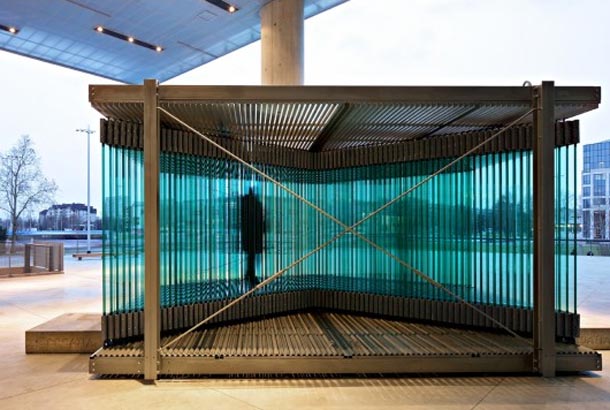
Although the installation was announced along with last year’s opening of the Museum within the Museum’s “Collections in Motion” set-up, it was never presented to the public due to an unfortunate turn of events where certain segments of the installation went mysteriously missing while stored in the “slaughterhouse building” following the Venice exhibition.
The authors were promised that the installation would be reconstructed, while tomorrow’s display of the installation confirms that the promise was made good on, thus the public will at long last have the chance to experience the glass steel versatile installation up close and personal – Frameworks, one of the few Zagreb MCA exhibits created by architects.

Upon presenting the installation a meeting with the young artists has also been announced, starting at 9:00 PM, where the authors will talk about how the installation came to being and how their fusion of art and architecture functions. The chat with the artists will be led by curator Nataša Ivančević.
An object of steel construction and parallel glass frames powered by an electric motor forms a tunnel placed in a dynamic continuous space. The tunnel connects the opposite entrances into the room. Each frame is placed on sliders, so it can be horizontally moved. When the frame is synchronously moved by the electric motor, the tunnel layout shape shifts, hence with every movement in a four-minute time span, the layout and tunnel’s intersection change shape, encompassing the visitors in the tunnel. Upon entering the tunnel, the viewer is introduced to a perpetually novel visual sensation with every movement of the glass frames.

photographs: msu.hr


